Paul Vogel · 7 September 2026
Engineering Approaches to Stabilizing Elevated Storage Platforms During High-Wind Events
Engineers address wind-induced forces on elevated storage platforms through systematic load analysis and structural reinforcements that distribute dynamic pressures across multiple anchor points. Standards such as ASCE 7 outline methods for calculating gust effects and uplift, which teams apply when designing platforms that sit above ground level on towers, rooftops, or framework supports. Data from field measurements show that peak wind speeds create both lateral shear and vertical lift, requiring integrated solutions rather than isolated fixes.
Wind Load Assessment and Modeling Techniques
Computational fluid dynamics simulations combined with wind tunnel testing allow researchers to map pressure distributions across platform surfaces before construction begins. These models incorporate terrain categories and exposure factors that adjust for urban versus open landscapes, producing force coefficients used in final sizing of members and connections. Observers note that platforms in hurricane-prone regions undergo additional checks for debris impact and cyclic loading that can fatigue joints over repeated storm seasons.
Software packages integrate topographic effects and directional wind roses so designers can prioritize reinforcement along prevailing storm tracks. When updated meteorological records become available, teams rerun analyses to verify existing installations still meet safety margins.
Mechanical Anchoring and Tensioning Systems
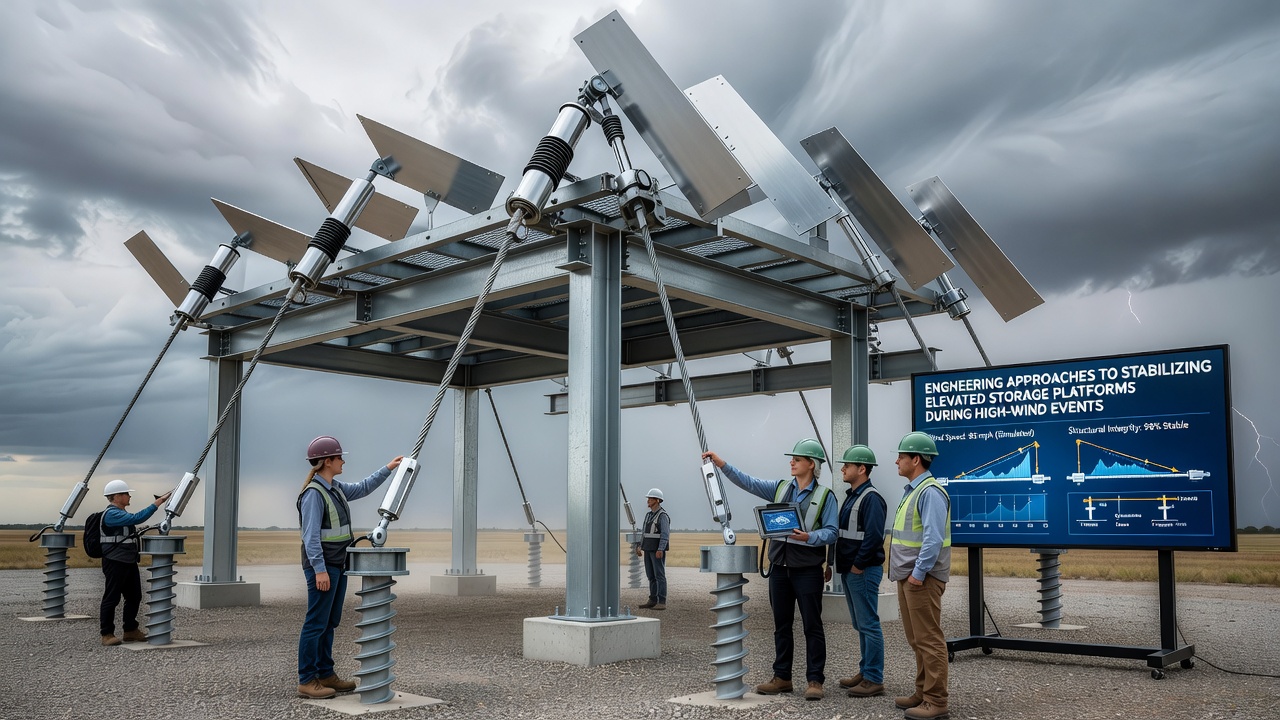
Steel cables and rod assemblies provide primary resistance by transferring tension forces directly into foundations or adjacent structural frames. Pre-tensioned guy lines maintain constant preload that counters uplift while permitting limited movement that dissipates energy. Engineers select materials with high yield strength and corrosion protection because platforms often operate in coastal or industrial environments where salt and chemicals accelerate degradation.
Base plates equipped with slotted holes and elastomeric pads allow thermal expansion without introducing stress concentrations that could initiate cracks during gust events. Installation crews torque connections to specified values and document readings so maintenance records reflect initial conditions for later comparison.
Supplementary Damping and Energy Dissipation
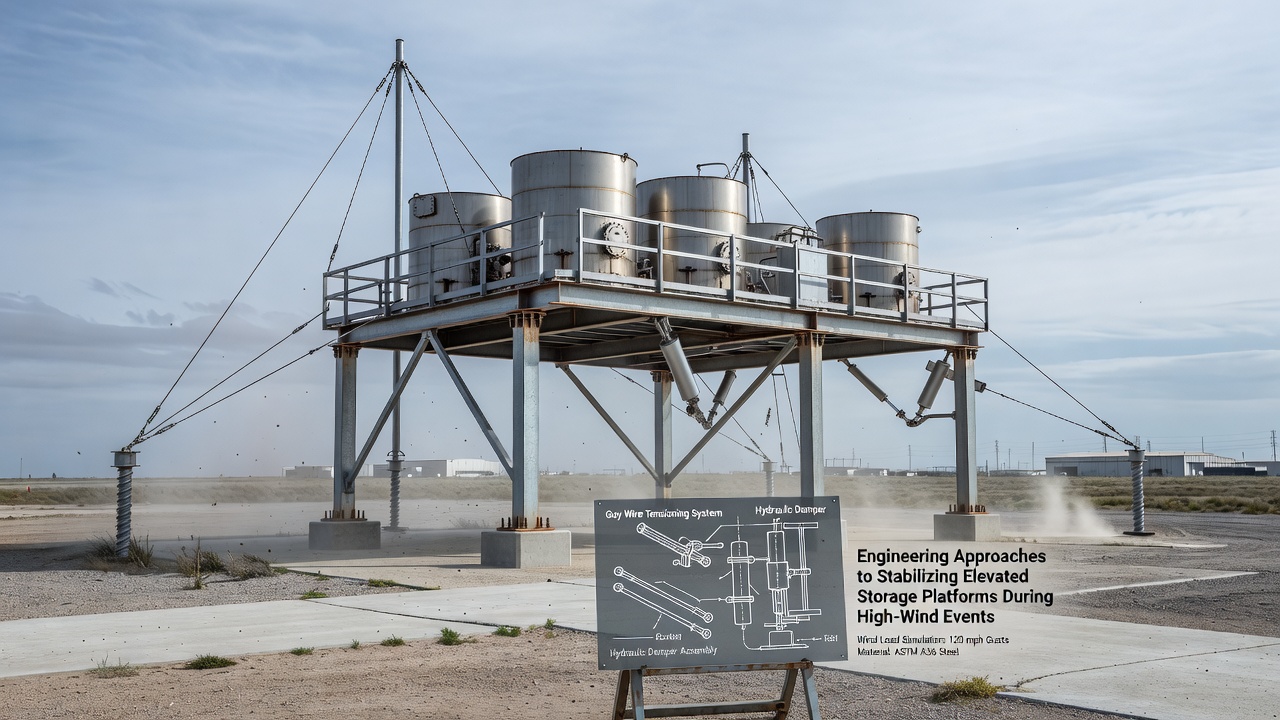
Tuned mass dampers and viscous fluid devices absorb oscillatory motion once wind speeds exceed service thresholds. These units attach at points of maximum displacement amplitude, converting kinetic energy into heat through friction or fluid resistance. Field data collected from instrumented platforms indicate that properly calibrated dampers can reduce peak accelerations by measurable percentages during sustained high-wind episodes.
Researchers at institutions studying structural dynamics continue to refine damper tuning algorithms that adapt to changing mass distributions when storage loads fluctuate seasonally. Some installations incorporate real-time sensors that trigger auxiliary bracing or alert operators when thresholds approach design limits.
Material Selection and Connection Detailing
Galvanized or stainless steel components dominate specifications because they retain mechanical properties after prolonged exposure to moisture and ultraviolet radiation. Bolted splices receive locknuts or thread-locking compounds that resist vibration loosening, while welded joints undergo nondestructive examination to confirm integrity before platforms enter service.
Composite wraps and fiber-reinforced polymers appear in retrofit projects where weight reduction matters or where traditional metals would introduce galvanic corrosion risks. These materials demonstrate consistent performance in accelerated weathering tests conducted according to international protocols.
Regulatory Frameworks and Regional Adaptations
Design codes from different jurisdictions prescribe varying safety factors and load combinations that reflect local wind histories. FEMA resources detail prescriptive detailing for critical infrastructure, while European Eurocode provisions emphasize limit-state verification across multiple wind directions. Australian standards incorporate cyclone categories that impose higher multipliers for regions subject to tropical revolving storms. Engineers cross-reference these documents when projects span international boundaries or require insurance compliance documentation.
Updates to wind speed maps issued by national meteorological services prompt reevaluation of older platforms, particularly those erected before current gust data became available.
Inspection Protocols and Long-Term Performance Monitoring
Periodic visual surveys combined with ultrasonic thickness measurements detect section loss or connection slippage before serviceability limits are exceeded. Drone-based photogrammetry produces point clouds that quantify any permanent deformation after major wind events, allowing rapid comparison against baseline geometry. Data loggers attached to select platforms record acceleration histories that feed back into probabilistic models used for remaining-life estimates.
Owners maintain digital twins that incorporate inspection findings so that reinforcement decisions rest on measured rather than assumed conditions. Training programs for maintenance personnel emphasize recognition of early indicators such as elongated bolt holes or fretting at cable clamps.
Conclusion
Stabilization of elevated storage platforms integrates load modeling, mechanical anchoring, damping technology, and material durability to maintain structural integrity under extreme wind conditions. Continued refinement of these approaches draws from field performance records and evolving design standards that account for changing climate patterns. Organizations responsible for critical assets apply these methods systematically to reduce downtime and repair costs associated with high-wind events.