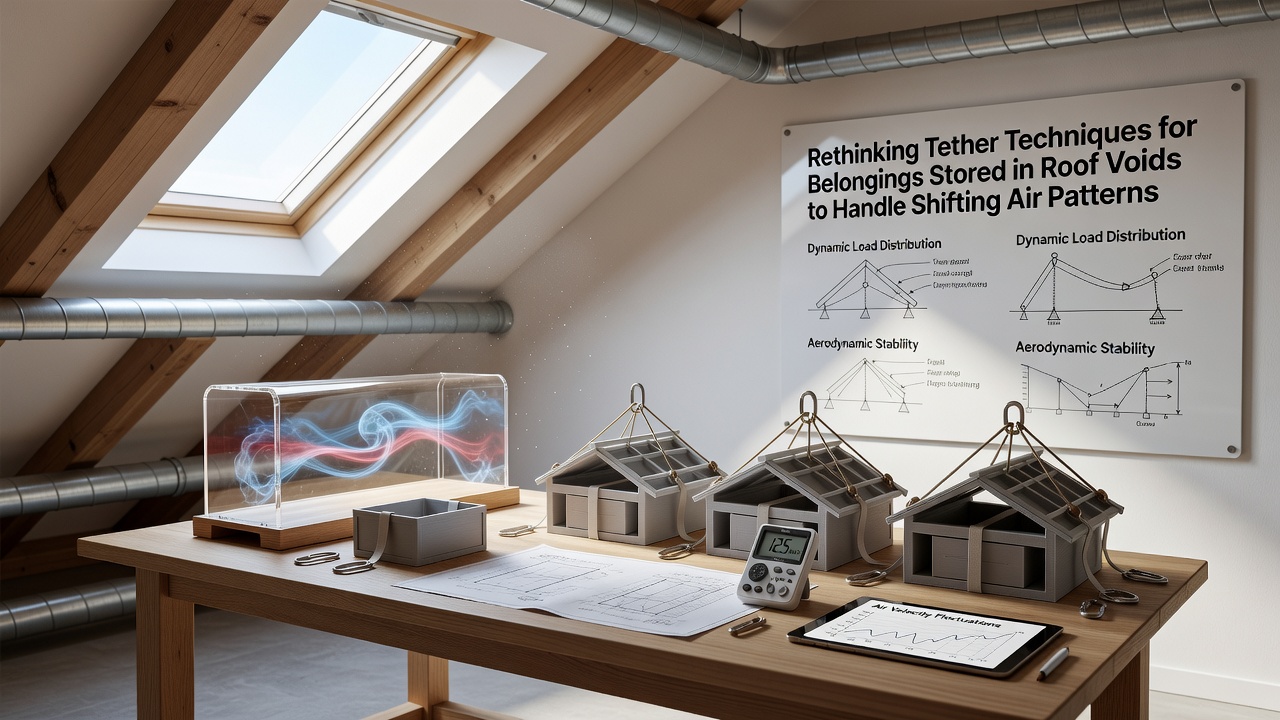
Paul Vogel · 21 September 2026
Rethinking Tether Techniques for Belongings Stored in Roof Voids to Handle Shifting Air Patterns
Roof voids present unique challenges for stored items because shifting air patterns created by temperature differentials, mechanical ventilation systems, and external wind loads generate consistent movement across stored belongings. Data from building performance studies indicate that these air currents often reach velocities sufficient to displace unsecured objects over time, particularly in structures with ridge vents or powered exhaust fans. Observers note that conventional tether methods frequently fail to account for the multidirectional nature of attic airflow, which changes direction based on seasonal pressure zones and daily thermal cycles.
Understanding Air Dynamics in Roof Voids
Air movement within roof voids follows predictable yet variable patterns driven by stack effect and cross-ventilation principles. Warm air rises through ceiling penetrations while cooler intake occurs at eaves, creating horizontal and vertical currents that persist even in mild weather. Research from the National Renewable Energy Laboratory shows these flows intensify during shoulder seasons when indoor and outdoor temperatures diverge sharply. Those who have monitored attic environments report that items positioned near ventilation paths experience greater displacement forces compared to centrally located storage.
September 2026 brings updated modeling tools from international building research groups that incorporate real-time sensor data on attic airflow, allowing more precise mapping of high-velocity zones. Such tools reveal that traditional rope or strap systems often leave slack points where repeated micro-movements erode holding strength over months rather than years.
Limitations of Established Tether Approaches
Many existing tether configurations rely on single-point anchoring to rafters or trusses, yet this approach leaves stored containers vulnerable to rotation when air pushes from multiple angles simultaneously. Figures from long-term monitoring projects demonstrate that items secured only at corners can still slide several centimeters per month under sustained low-velocity drafts. The reality is that fabric straps stretch incrementally under cyclic loading, while metal hooks corrode in humid conditions common to roof voids.
Engineers have tested alternative configurations that distribute tension across multiple attachment points simultaneously. These setups use adjustable tensioners positioned at both ends of each tether line, which maintains consistent pressure even as ambient conditions fluctuate. Data collected across test structures in varied climates indicate measurable reductions in item migration when compared against baseline single-anchor methods.
Emerging Materials and Configurations
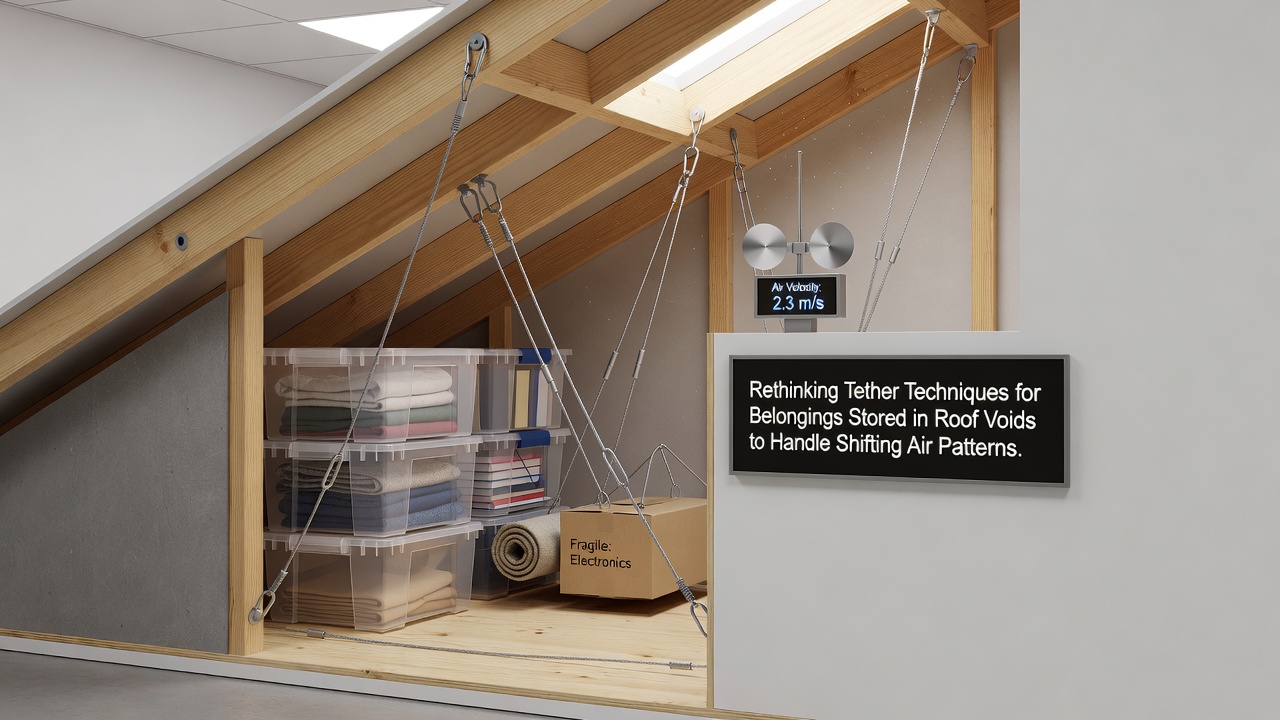
New tether materials incorporate UV-stabilized polymers and corrosion-resistant coatings that withstand the temperature swings and occasional moisture exposure typical in roof voids. Researchers at CSIRO have documented performance improvements when these materials replace standard nylon webbing in controlled exposure trials. Configurations now under evaluation combine rigid spreader bars with flexible tension members, which prevents containers from rocking while still permitting minor structural movement of the building itself.
One study revealed that integrated sensor feedback loops, though still emerging, allow tension levels to adjust automatically in response to detected air velocity changes. While full-scale adoption remains limited, pilot installations in commercial buildings show promise for high-value storage applications where displacement risk carries significant consequences.
Implementation Considerations Across Building Types
Older homes with irregular rafter spacing require custom anchor placement strategies that newer constructions avoid through standardized truss designs. Building codes in several regions now reference specific load calculations for storage restraint systems, drawing from wind tunnel research adapted to internal attic conditions. Those responsible for maintenance programs increasingly document initial tension settings and schedule periodic inspections to verify continued performance.
Coordination with insulation upgrades presents another variable because added material can alter airflow paths and create new pressure differentials around stored items. Projects that address tethering before insulation work begins tend to achieve more stable long-term results according to project reports from multiple contractors.
Conclusion
Shifting air patterns in roof voids demand tether techniques that address multidirectional forces rather than simple gravitational stability. Advances in materials and anchoring configurations provide measurable improvements when properly implemented. Continued monitoring and adaptation of methods based on building-specific airflow data support more reliable outcomes for belongings stored in these spaces.